In the world of online shopping that continues to grow, Poshmark is gaining popularity. While convenience, a wide range of products, discounts, and competitive pricing make the platform successful, you might be wondering if Poshmark is legit and reliable. While the answer to both questions is yes, there are still many Poshmark scams that you should be aware of. In this report, we look into the threats and how you can keep safe.
What is Poshmark?
Poshmark is a legit US-based marketplace platform where users can buy new and secondhand fashion. Sellers on the platform also list electronics, home goods, pet supplies, toys, and games. The site has over 130 million users and hundreds of millions of listings by all types of sellers, from known brands to individual resellers.
Another thing that Poshmark has is bad customer reviews. And, like all major online marketplaces, the platform has a reputation for being the target of several online shopping scams, despite its reliability.
Is Poshmark legit?
Yes. Poshmark is a legitimate company with customers in the United States, Canada, Australia, India, and other countries.
Poshmark began operations as a Delaware-registered corporation. Publicly listed on the NASDAQ under the ticker POSH in January, 2021, the company was acquired by the South Korean tech giant Naver Corporation for $1.2 billion in cash and was delisted from the NASDAQ in 2023. The company now acts as a private subsidiary.
Is Poshmark safe to buy from? While Poshmark is safe and legit, customers complain about gaps in buyer protection and unresponsive customer support. On TrustPilot, customers gave the company 1.2 stars out of 5. These issues are not unique to Poshmark, as most high-volume online shopping marketplaces struggle with them.
Poshmark scams target its userbase, manipulating the platform’s system, making out-of-platform requests, impersonating the brand in phishing messages, and using other scamming tactics.
What is Posh Protect?
Poshmark’s Posh Protect consists of policies and systems to protect its users in the marketplace. These policies are in place to protect you from Poshmark scams.
Under Posh Protect, the company works with an escrow payment system. This means that the platform holds the payment for all products, as a neutral middleman between buyers and sellers. It then releases these payments when “certain conditions of the transaction are met.”
This type of system is common in online marketplaces. Platforms use these setups to help protect the interests of both the buyers and sellers. Bottom line: If you buy something at Poshmark, the company will hold the payment until you get your product in good shape.
Can you get a refund through Posh Protect?
Posh Protect only refunds you if you didn’t receive your item or if the item does not match your listing. “Otherwise, all sales are final, and no refunds will be provided under Posh Protect,” the company says on its Posh Protect official page. This is a common complaint among buyers.
Users have a 72-hour window (3 days) after product delivery to report a problem with a purchase. Problems you can report during this window include:
- Undisclosed damage
- Incorrect or missing item
- The item is not as described
- The item is not authentic
- Order never shipped/received
After reporting the problem, users have 5 days to use a new label that Poshmark will reissue to return the product to the seller. If the user does not comply with this process, no refund is available.
If no return case is opened within 3 days of delivery, payment will be automatically released to the seller. Once payment has been released, all sales are final. No refunds will be provided under Posh Protect.
Issues not covered under Posh Protect include:
- Items that do not fit
- Users who changed their minds and don’t want the product anymore
- Out-of-platform transactions, where the purchase began on Poshmark but concluded outside of the marketplace
This final point is associated with a common scam that we will address below, as scammers commonly try to convince users to act off-platform.
Are sellers’ IDs verified by Poshmark?
If you are wondering whether Poshmark is safe to buy from, you might want to know that the platform does not verify all its users by asking them for government-issued IDs. Poshmark’s identity verification policy is crystal clear on that.
Through its Sellers Verification policy, Poshmark does not verify the identity of all sellers. Only some are requested to submit government-issued ID verification documents. Individual seller accounts also have less scrutiny than business accounts, which must submit business information and documents. Poshmark scammers leverage this lack of comprehensive ID checks in their favor.
If you are asked to complete an Identity Verification by Poshmark, you will need to do it through the app, not through your browser. Valid forms of ID include a valid form of identification, a driver’s license, a passport, and a state-issued ID.
How Posh Protect checks for scams and risky activity
Let’s look a bit more closely at how Posh Protect checks for scams and suspicious behavior to make Poshmark a safe place to buy from:
- You buy something on Poshmark: Once you click on “Buy Now” on a product on Poshmark, you will be immediately charged for the item. Poshmark, acting as a middleman, will lock that payment in a secure escrow account. Poshmark notifies the seller and provides them with a trackable USPS shipping label, giving the seller a window to ship the item to you, the buyer.
- Your product is on its way. In this step, the seller ships the item using the Poshmark-issued USPS label, which is tracked by the platform and is updated on your “status” details.
- Your package has arrived. Once your purchase arrives, it is automatically marked as “Delivered” on your Poshmark account. This is the start of the 3-day product review window (72 hours), which we spoke of in the section above. At this stage, the funds used in the purchase are still locked by Poshmark. This is when you should inspect the package.
After your package arrives, things can get a bit tricky. At this stage, 3 possible scenarios may emerge.
First, the package is fine, and you approve it on the platform by clicking on “Accept Item.” Think twice before clicking that button. Once you do, the 3-day inspection window closes, and Poshmark releases the funds to the seller. You can claim no refunds.
Second, if you inspect the purchase and find that the item is damaged, is a counterfeit, or does not match the description, you have 3 days to open a case, explain the problem with the order, and send supporting photographs. Opening a case will automatically freeze the funds in escrow until Poshmark support reviews the claim. Poshmark will issue you a paid return label and refund your money only once the seller gets back the faulty product. You have 5 days to drop the return package off at a post office.
Finally, the third scenario: In a Poshmark no-shipping scam, if you received the package but did not check its quality or state, and the 3-day window expired, you have lost the chance to open any case. Poshmark will release the purchase funds to the seller. No refund is available if this happens.
How Posh Authenticate verifies designer and luxury products
Posh Authenticate is a trustworthy system developed by the company for items listed at $500 or above. These show an “Authentication Included” notice on the app and marketplace listing. The system is meant to help keep Poshmark safe for buyers looking to spend more than $500 on authentic items.
When you buy one of these products, the buyer sends it to Poshmark, where a team of in-house experts verifies the product, unless the seller is categorized as a trusted independent partner by Poshmark. In that case, the seller will ship the product directly to you.
The team of Poshmark experts will examine the product, looking for damage, quality, matches to description, and tags and logos, checking for counterfeits. If they determine that the authenticity of the product cannot be confirmed, you get a full refund. If they give it the green light, Poshmark repackages the product and sends it your way.
Buyers are kept informed and updated on the state of these $500 or above purchases via the app. It usually takes 1 to 3 business days for Poshmark’s team of experts to review these products. However, this timeline may be expanded depending on how busy the team is and other things.
Only fashion products above $500 are eligible for Posh Authentication.
This system opens up several gaps that scammers leverage, including:
- The $499 sweet spot: Scammers sell products at $499 to avoid the strict security system of products priced at $500 or above.
- Pay me the rest “out of platform”: Scammers might list high-priced luxury items valued at $1,000 or above (such as Louis Vuitton, Gucci, or Chanel pieces) at $499 and tell buyers they can pay the rest off-platform, opening the door to scams and frauds.
- Too good to be true: Scammers might list counterfeit products at $499 and offer them as exclusive deals or one-time discounts, again bypassing the guardrails that products above $500 have.
While not all $500 products on Poshmark are verified through Posh Authenticate, buyers are familiar with the system. If you are spending $500 or more, a good idea is to search for the Poshmark Authenticate badge on the product.
How to identify Poshmark scams and warning signs
From off-platform payment scams to phishing, return swaps, and fake support, there are many Poshmark scams. All of them depend on social engineering; these are ways in which scammers trick you into falling for a trap.
Scammers are now using AI to develop more convincing emails, messages, and even phone calls. Do not underestimate them. Fortunately, Moonlock’s Scam Detector can catch what you miss.
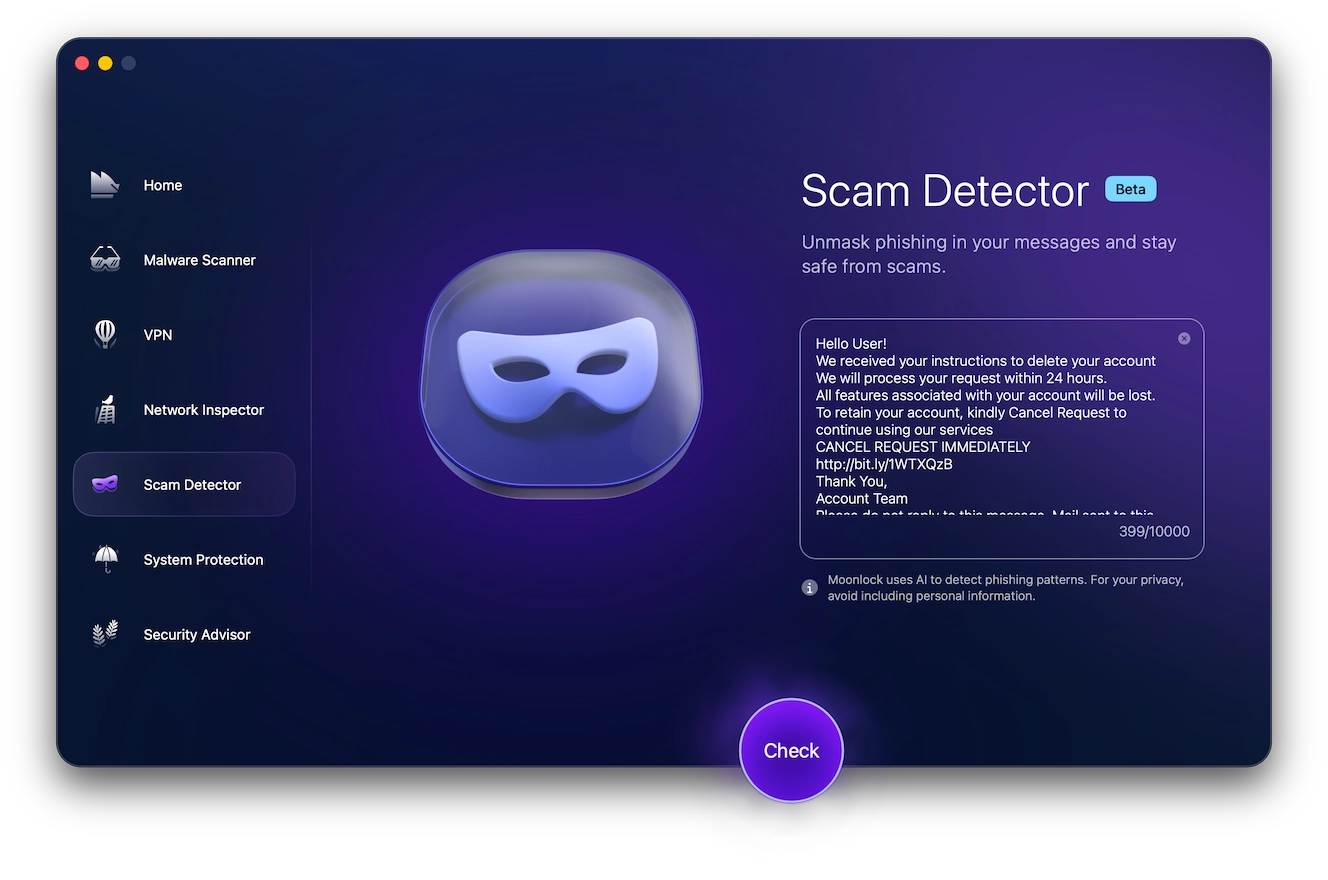
The Moonlock antivirus can remove Mac malware, but the Scam Detector can help you identify potential fraud. Here’s how to use it to identify fraud on Poshmark:
- Sign up for a free 7-day trial of Moonlock.
- Open the Scam Detector on the left.
- Copy the text of the suspicious email or text message.
- Paste the text into the Scam Detector.
- The Scam Detector will analyze the text, report the likelihood that it is associated with a scam, and explain what to do next.
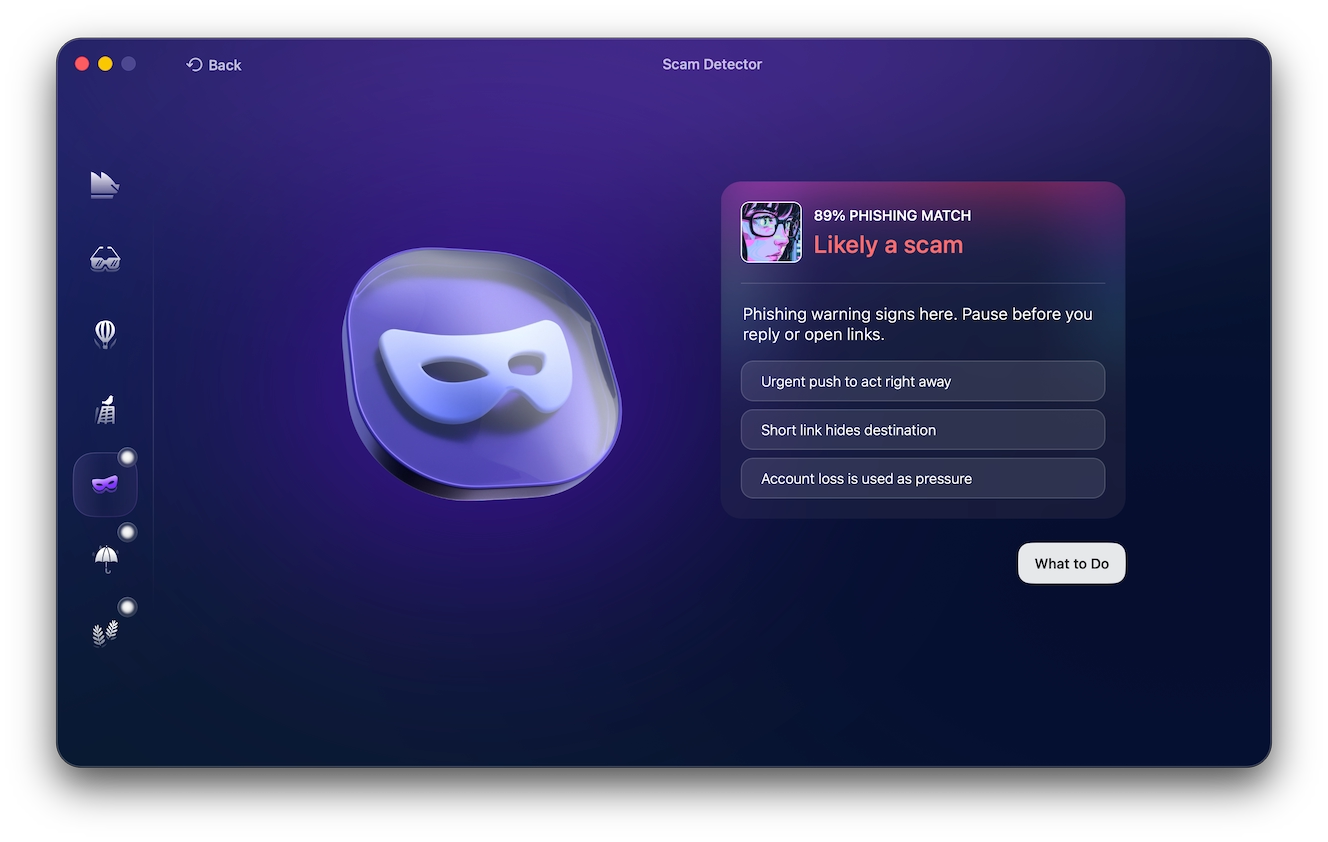
The Moonlock app’s Scam Detector works by identifying common red flags in scams. Let’s learn more about those red flags in the section below.
Red flags in Poshmark seller scams
If you are a Poshmark buyer concerned about seller scams, the following are some of the most common red flags to take note of:
- Off-platform buying: Any seller asking you to sell an item or communicate off-platform via email, SMS, social media, or any other channel is likely setting you up for a scam.
- Counterfeit items: The counterfeiting underworld is massive, and platforms like Poshmark are a prime target for scammers selling these fake products. Make sure you are not buying a counterfeit. Check the price, reputation, and verification of the seller, and ask questions. When your product arrives, check it carefully to see if it’s the real thing. Keep in mind that counterfeits today can appear very authentic.
- Sellers with multiple identical products listed: Scammers will create multiple listings for the same product that does not exist. They do this to keep their traps active. Stay away from sellers that have identical product listings.
- Sellers with low activity and a bad reputation: Poshmark sellers are reviewed by buyers in a 1- to 5-star system. Buy from sellers with high activity and good reviews.
Red flags in Poshmark buyer scams
A couple of signs of buyer scams you should look out for when selling on Poshmark include:
- Out-of-platform requests: Any request from a buyer to negotiate or pay off-platform will automatically get you off the Poshmark security system, where there are no guardrails.
- Data requests from users: Scammers use personal data to enhance their scams, so be suspicious of any buyer asking you for personal data, including your email.
- Last-minute change of address: A common scam involves asking sellers to change the shipping address at the last minute. Scammers do this to avoid using the USPS label that Poshmark issued for the sale. Sales without the Poshmark label are not protected and can be manipulated. Scammers can claim the item never arrived, keep the product, and the cash.
- Buyers who make strange demands: Be on the lookout for any buyer making strange demands before, during, or after they purchased a product; they might be setting up the stage to make fake refund requests.
Why Poshmark is commonly targeted by scammers
Poshmark is targeted by scammers because it is a high-volume online shopping marketplace. Basically, scammers go where the money is and will find gaps in any system.
Gaps in the Poshmark system include:
- The 20% commission problem: Poshmark’s 20% commission on all sales, steep compared to other marketplaces, is used as an excuse by scammers for off-platform negotiation scams.
- AI makes scams more sophisticated: AI is now being used by scammers to create hyper-personalized emails and launch large phishing campaigns. There are even AI voice scam-agents who will talk to you on the other side of the phone. ChainAnalysis recently found that impersonation scams have increased a massive 1,400% year over year, driven by AI. AI scams are 4.5 times more effective than common scams, the report found.
- Counterfeit fashion hotspot: The global fashion counterfeit industry is estimated to be valued at about half a trillion dollars. Those working in this black market industry see Poshmark as an ideal platform for business.
- Authentication only covers items over $500: As mentioned above, the $499 sweet spot is used by scammers in many ways to avoid higher security checks.
- No private messaging: Scammers often try to move conversations to email, Telegram, WhatsApp, or text messages immediately to avoid Poshmark’s protections and moderation systems.
- Posh Protect can be unbalanced: Depending on how the system is manipulated, the Posh Protect system, USPS labels, window timeframes, and refund policies can make Posh Protect unbalanced, sometimes leaning in favor of buyers, and other times in favor of sellers.
- No mandatory ID verification for account creation: Poshmark does not verify the ID of all sellers.
- Poor customer support: Customers commonly complain that customer support on the platform is slow or unresponsive. Poor customer support only works in favor of scammers.
- Products that are nothing like the listing: While there is a refund policy for products that do not match the description, the timeframe to check them can be rushed, and the process of returning products can be annoying. This is also leveraged by scammers.
Poshmark scams affecting buyers and sellers
Now that we’ve covered the basics, let’s dive into the specific details of the most popular scams targeting Poshmark sellers.
Common scams aimed at Poshmark sellers
Tactics have changed in 2025 and 2026. Not only is the use of AI notable, but scammers have leveled up their game and moved to new channels.
Today, scammers are more technical. They can create entire websites, draft highly convincing emails, and manipulate the account creation system of Poshmark, as well as other security processes involved. They also have tools that allow them to automate and scale scams to never-before-seen levels, spoof phone numbers, and manipulate USPS tracking tags.
Off-platform payment scams
In this type of scam, sellers are approached by scammers who pose as buyers or potential interested customers and try to lure them off the platform. They do this to bypass all the protection systems in place in the marketplace.
Phishing emails pretending to be Poshmark
By using stolen user databases bought on the dark web and AI, scammers can draft highly convincing emails that look just like legitimate emails from Poshmark. Poshmark impersonation phishing emails often come with a phone number. The number may lead to a Scam call center. Alternatively, individual scammers may try to convince you to give away your data. Emails can also come with malicious links to fake, cloned Poshmark sites, where your credentials are stolen the second you type them in.
Return fraud and item swaps
This scam is as simple as it is effective. A scammer will buy a product on Poshmark, usually high-value ones. When they receive the product, they open a case claiming the product was damaged despite the product being in good condition. The scammers then return another identical damaged product that they had in their possession and demand a refund. Sellers might think the product was damaged in shipping.
The scammers can also claim that they received a different product and submit fake pictures of any product they have on hand when doing scams on Poshmark.
Changed address or shipping redirect
If you get a last-minute request to change the shipping address of one of your sold products on Poshmark, it’s probably a scam. Scammers are trying to trick you into changing the Poshmark USPS label tracked by the system.
If you change the Poshmark-issued label and send the package anyway to keep a customer happy or for any other reason, scammers will claim they never got the package and keep the order plus the refund money. Poshmark will give them a discount because the data on the USPS tag they gave you says you never shipped it.
Bundle offer scams
Scammers love high-value Poshmark bundle offers for a simple reason. When the package arrives, they falsely claim that one or several of the items in the bundle are missing. They will open a case, submit fake photos, and ask for a refund. When scammers return the package, they simply leave out the item or items that they claim not to have received.
A good idea if you are selling high-value bundles is to continuously film the packaging process or simply break up the offer into individual items.
Another way that scammers manipulate bundles on Poshmark is through the bundle’s comment section. While this section is public and can be seen by any user, it usually goes unnoticed by everyone except the buyers and sellers. Scammers use fake accounts, taken-over accounts, and bots to comment in these sections and kickstart off-platform scams, provide malicious website addresses, or run the first part of other scammer scripts.
Fake order confirmations
In this type of scam, you get an email, a text, or a phone call from scammers impersonating Poshmark. The design, layout, and even logos on the email or message look very authentic. These fake order messages are used as the stepping stone to different versions of the fake order confirmation scam.
Using these fake order confirmation messages, scammers might ask you to verify your account and direct you to a fake Poshmark scam site that steals your credentials, or insist that you owe “fees” and trick you into making payments or giving away sensitive data.
Fake support scams
This scam is exactly what it means: a fake support scam. Scammers now use AI voice agents to launch these scams at an industrial level. Those who have been on the other end of this scam claim that the AI voice-scam agents speak just like real humans.
Chargeback fraud
Chargeback fraud is among the nastiest that sellers can experience. Not only do you lose the product and possibly the cash, but your account is flagged for committing illicit or suspicious activity in this Poshmark scam.
In a Poshmark chargeback scam, scammers buy items and then file a dispute with the bank or credit card they used to buy the item. While the dispute is not filed against the seller, if the product was listed as “Buy Now-Pay Later” and the credit card charged was disputed, the “Later” funds might never arrive. The same goes for payments for high- or low- value items made under installments.
The dispute filed by scammers with the bank also contains the seller’s information. Fraudulent disputes could end up being the target of police and law enforcement investigations, and data connected to them can be flagged.
Overpayment scams
This type of scam actually requires the scammer to first convince the seller to go off-platform. Once outside of Poshmark, the scammer will claim to have made a payment larger than the original price of the product sold and ask the seller to refund the excess amount. The scammer will show the seller fake payment confirmations and use social engineering to pressure the seller into returning the excess funds without checking the balance.
On a large scale, for businesses and sellers that are highly active, this scam is even more efficient because checking account balances when you have hundreds of sales can be annoying and challenging, especially if a scammer is pressuring you to release the funds.
Poshmark scams buyers should watch for
On the other side, buyers also need to look out for some red flags. There are several evolving scam scripts targeting them. Find below the most trending.
Fake listings and unshipped items
When buying on Poshmark, make sure the seller has a strong reputation and a variety of listings. Scammers will create fake listings for popular and high-value products that they never ship or send counterfeit items instead.
To bypass the Poshmark security system for shipping items, scammers will digitally modify your address in the USPS tag given by the platform. The package is shipped—just not to your house. Meanwhile, you get a message from Poshmark saying your purchase has arrived. Scammers then run down the 3-day window clock that buyers have to open a refund case, and the funds are released to the scammer.
Counterfeit goods scams
In this classic Poshmark scam, counterfeit high-end or trending items are sent to try to pass as legitimate products. Keep an eye on the price. If it’s far cheaper than it actually costs, it’s probably counterfeit. Counterfeit items today can look, and even feel, very authentic, so buyers often don’t know the difference until the 3-day window to open their refund case on Poshmark passes.
Account takeover
Scammers can take over small, medium, and large sellers’ accounts and either use the listings that the account already has or create fake listings to sell products they will never ship. They take over accounts because these existing accounts have buyer reviews and recent activity, such as comments. These are factors that normal buyers check for trust, so taken-over accounts are attractive to scammers.
Once you buy a product on these taken-over Poshmark accounts, scammers will manipulate the USPS Poshmark labels and tags, then stall you by using social engineering tricks to run down the 3-day refund window clock.
How secure is Poshmark compared to other resale platforms?
Let’s look at how other popular online marketplaces compare when it comes to scams.
Poshmark and Shein are both mostly known for focusing on fashion. Shein operates from Asia and is known for its low prices. The platform is also linked to many counterfeit scams. Scams on this platform also try to bypass the app’s systems, so risks of fake shipping, phishing, and fraudulent accounts exist.
Shein has also gained a bad reputation for its lack of transparency, environmental policies (or lack of), and other more concerning issues. Read the full Moonlock article, “Is Shein safe? An honest look at the ultra-affordable shopping site,” to learn more about this Asian-based online marketplace.
On the other hand, Facebook Marketplace scams often involve products not listed on Poshmark, such as cars. These scams include fake car rental scams and damaged car sales scams.
On Facebook Marketplace, you might also come across the usual fake shipping, account takeover, and overpayment scams. But, more importantly, because there is no escrow system on Facebook Marketplace like there is on Poshmark, payment scams are more varied. These include QR code payment scams and Venmo scams.
Finally, Temu scams are similar and include counterfeits, low-quality items, and customer service impersonations. However, there are several issues linked to the company’s reputation and how the app manages your data. You might want to read up on these before buying an item there.
Steps to take if you’re scammed on Poshmark
If you have been scammed on Poshmark, there are several things you can do to stay safe. Below you’ll find some recommendations, tips, and suggestions to keep your Poshmark account, your purchases, and your sales safe:
- Report Poshmark phishing scams. If you are a seller or a buyer and received a phishing email, report it by forwarding a copy of the email or message to [email protected]. Then block and report the email on your email provider.
- Change your password. If you have noticed suspicious activity on your Poshmark account, secure it by changing your password. Make it a strong one because, to date, Poshmark does not have 2FA. Regularly changing your password also makes your defense stronger.
- Do not accept the order until you are 100% satisified. Never click on “Accept Item.” This will release the funds to the scammer, eliminating any opportunity for a refund.
- Open a case if you’ve been scammed. To get a refund, you need to open a case. Go to your Account Profile tab, then My Purchases, and select the scammed order. Click on Problems/Order Inquiry, and then choose the option that fits your situation: Item Not Received (for fake tracking/mail fraud) or Item Not as Described (for counterfeits or empty boxes).
- Learn how to build a strong case for a refund. To get a swift refund when scammed, you need to build a strong case. To do that, you can take photos of the product, packaging, and everything else you think might help customer support to resolve the issue quickly.
- Learn how to resolve no-shipping scams. If your purchase hasn’t arrived but Poshmark lists it as “Delivered,” go to your local USPS. Ask the manager for printed proof based on GPS coordinates that the package was delivered to a different address. Submit all your photos and documents to Poshmark Support and ask for a refund.
- Do not share your personal data on Poshmark. Scammers aren’t just looking to make a quick buck. They also want your personal data. They can use it to create highly convincing phishing emails, sell it to other bad actors, or launch scams and cyberattacks.
- Scan your Mac for malware. With 90% of all cyberattacks starting with a phishing message, scanning your Mac for malware is the best way to go.
From stealers to spyware, many pieces of macOS malware are in the wild today, and they’re widely available to cybercriminals and scammers. This malware can breach Gatekeeper, your Mac’s built-in line of defense. The Moonlock security app helps catch what your Mac’s security misses.
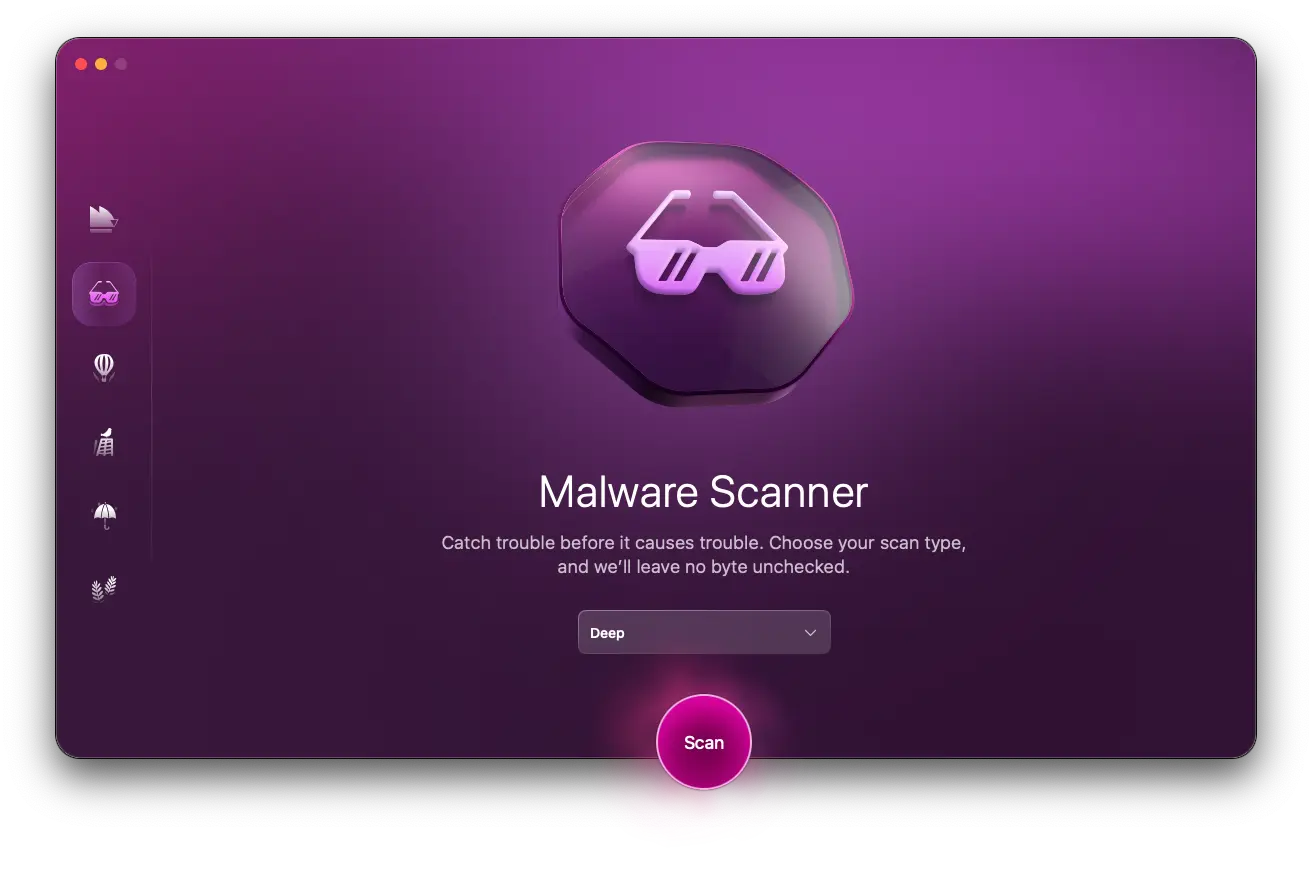
In addition to real-time protection, which checks everything you interact with for malware, the Moonlock app has a built-in Malware Scanner that leaves no stone unturned. You can customize and schedule deep scans at your convenience. If Moonlock finds anything, it will tell you exactly what it is, why it’s dangerous, and what to do next.
To scan your Mac for malware using the Moonlock app:
- Test-drive Moonlock for free for 7 days.
- Download the Moonlock antivirus.
- Click on the Malware Scanner icon on the left-hand menu (sunglasses icon).
- Run the recommended scan or configure the Malware Scanner. It can scan your Mac in 3 different modes: Deep, Balanced, or Quick. Each mode balances speed versus scan depth. A good idea is to run a Deep scan the first time you open up the Moonlock app on your Mac. It will scan your entire system, including all folders and files on your Mac, without slowing down your computer.
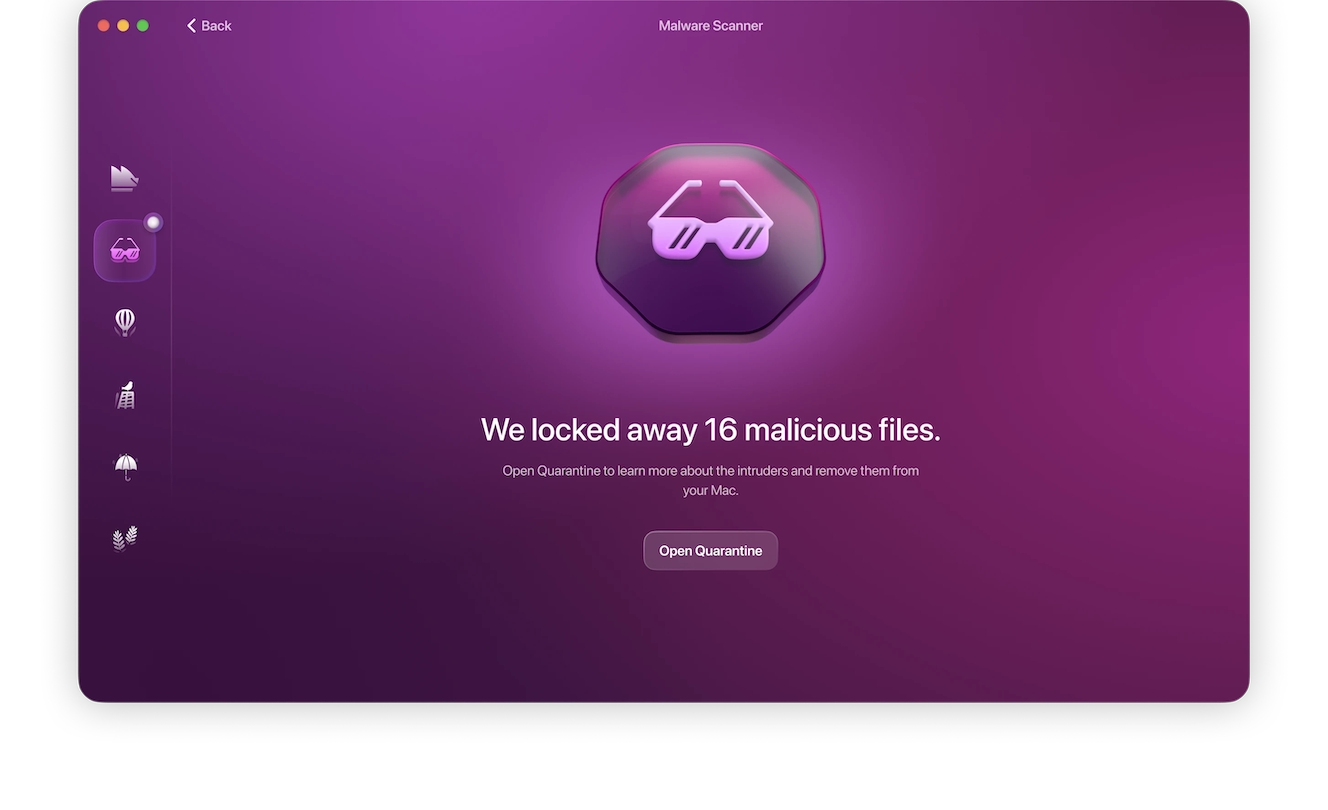
- Once the Malware Scanner is complete, it will let you know if your Mac is safe and alert you to detected malware. If malware is found, the scanner will automatically move it to Quarantine, where it is locked down and can do no harm. You can check out Quarantine in your own time, learn more about the threat, and remove it completely from your Mac.
Simple tips for buyers and sellers to stay safe on Poshmark
Below are some suggestions and tips that can go a long way toward having a safe shopping experience at Poshmark and other online marketplaces:
- Choose a strong password. Poshmark does not have 2FA, so make sure your password is unique and strong.
- Check sellers’ customer reviews, listings, and activity. Ask yourself, is the seller active? How do other buyers rate them? Are their listings duplicates? Verify this to make purchases safer.
- Do not engage “out-of-platform.” Scammers will make up a lot of different scenarios to get you to pay or talk out of Poshmark. As a golden rule, if it’s out-of-platform, it’s a scam.
- Know how to open a case for issues with purchases. Make sure you’re aware of Poshmark’s system and the time period you have to open cases and ask for refunds. This is key to avoiding many scams, from fake shipping to counterfeits.
- Watch out for personal data requests and unsolicited messages. If you receive unsolicited emails, SMS, or Poshmark comments, they are likely associated with scams. Scammers are not just looking to steal your purchase or listings but also to steal your personal data.
- Use the Scam Detector. Scammers are using AI to create phishing emails that are increasingly difficult to flag. The Moonlock app has a built-in Scam Detector that will check phishing emails in just a couple of clicks. All you have to do is copy and paste the message in the Scam Detector, and it will tell you if it’s safe, if it’s a scam, and why.
Unfortunately, as an online shopper or seller today, there are several scams you need to be aware of. Pretending that there are no online shopping scams, or that they will never affect you, is not the best way to go. Instead, learn more about scams and take some simple but highly effective steps to have a reputable, happy, and safe online shopping experience.
This is an independent publication, and it has not been authorized, sponsored, or otherwise approved by Apple Inc. Mac and macOS are trademarks of Apple Inc.